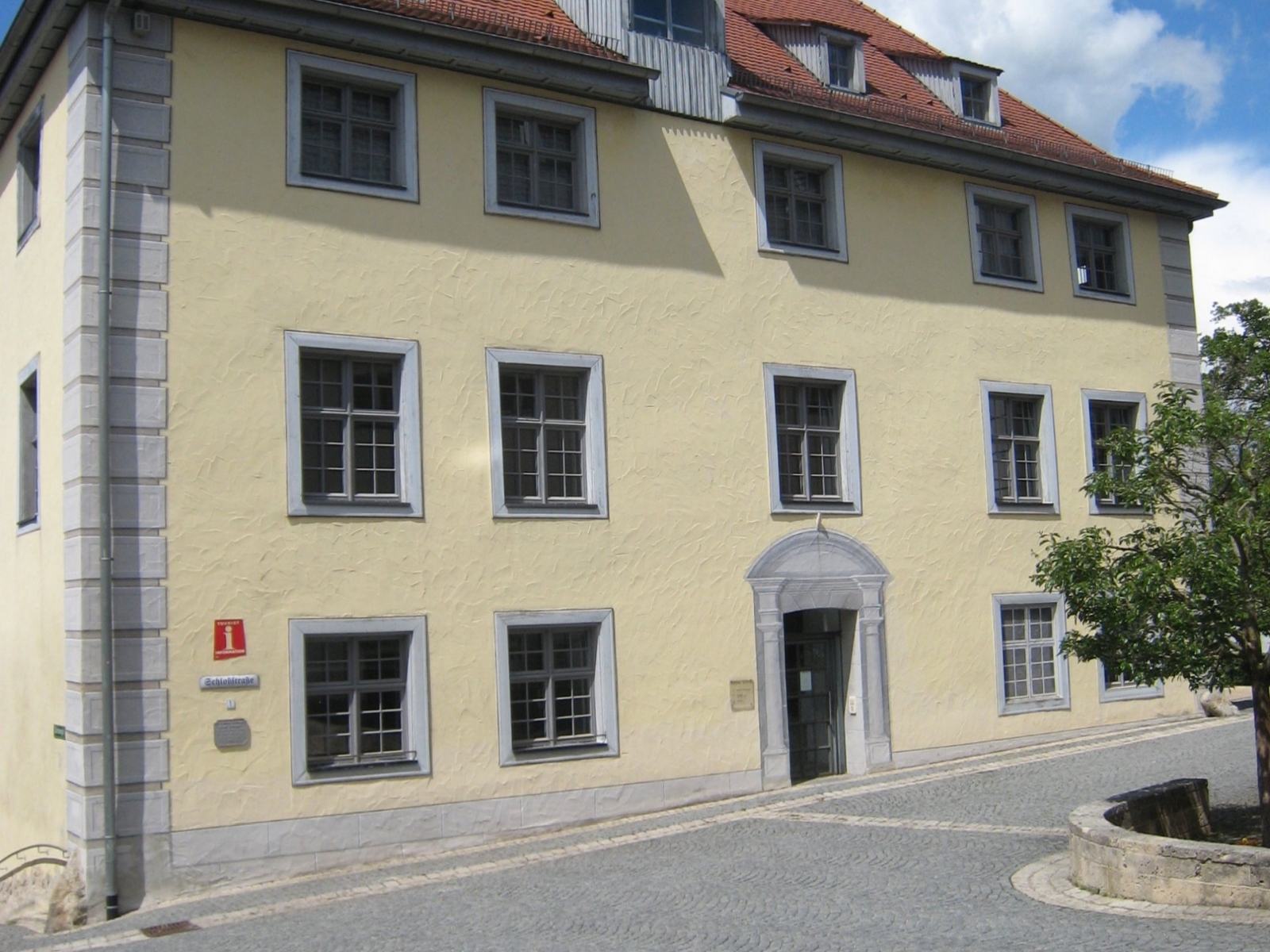
Welcome to Museum "Vorderes Schloss"
The museum in the Vorderes Schloss in Mühlheim, together with the museum in the Ifflinger Schloss in Fridingen, forms the Upper Danube Valley Museum. In addition to a permanent exhibition, both museums also host several special exhibitions each year.
**The permanent exhibition at the museum in the Vorderes Schloss comprises four sections:**
**City and Feudal History**
Mühlheim was granted city status by the Counts of Zollern before 1241 and belonged to the Barons of Enzberg from 1409 onward. This noble family shaped the city’s history until 1806. The relationship between the city and the feudal lords was regulated by the city charter of 1511, but remained tense until the very end. The farming town, characterized by its crafts, suffered greatly during the Thirty Years’ War and had only 600 inhabitants when it was transferred to Württemberg in 1805. The industrialization of the 19th century provided the town with a way out of its traditional poverty.
**Church History and Popular Piety**
One section documents the history of the church and religious life in Mühlheim since the High Middle Ages. On display are liturgical objects, valuable sculptures, and paintings. The ecclesiastical order of Catholic rule shaped urban life down to the private sphere. The veneration of saints, processions, and pilgrimages characterized Baroque popular piety.
**Welschenberg Pilgrimage Church**
Immediately after the Thirty Years’ War in 1649, the Marian pilgrimage to Welschenberg between Mühlheim and Fridingen began. Sponsored by the House of Enzberg, the pilgrimage reached its peak in the 18th century with visitors from Upper Swabia and Alsace. The Napoleonic Wars brought the pilgrimage to an end; the last Mass was held in 1812.
**The Painter Josef Alfons Wirth**
Josef Alfons Wirth (1887–1916), a native of Mühlheim, received his artistic training in Stuttgart under Christian Landenberger. Initially working in the tradition of French Impressionism, he followed his friend Otto Meyer-Amden into mysticism beginning in 1912 and experimented with Cubism under the influence of Oskar Schlemmer. Wirth’s early death on the Western Front in 1916 cut short a promising career.
Exhibitions by the Mühlheim Local History Association in the attic, as well as a collection of minerals and fossils in the basement that opened in 2017, round out the museum’s offerings.
**Guided Tours of the Museum**
Guided tours are available at any time by appointment. Please contact the Cultural Office (07463/9940-22) or the [Heimatverein Mühlheim e.V.](https://www.heimatverein-muehlheim.de/) directly.
Source: DZT Knowledge Graph